
Chairman Tony Cobb welcomed members to the 522nd meeting of Henley Men’s Probus.
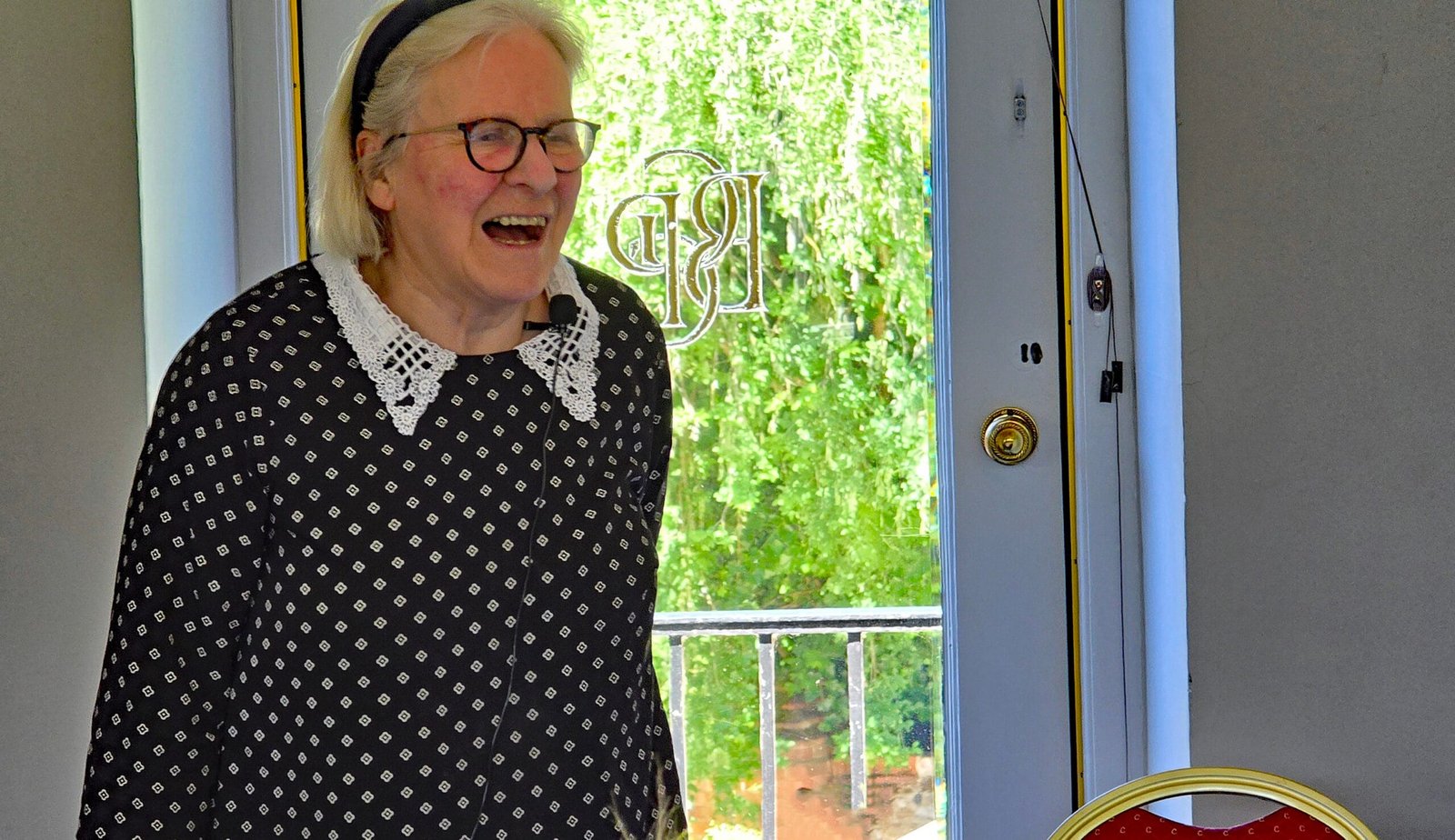
Following a brief business meeting President Viv Emerson introduced Joanna Bogle who gave us a fascinating and informative talk entitled The Life and Work of Sue Ryder. Joanna, a seasoned journalist, explained that she was asked to write Sue Ryder’s biography and jumped at the chance but was initially hindered in her research by the lockdown during the recent pandemic. She explained that while all museums, libraries etc were closed she started her research both via the internet and by having telephone conversations with those who knew and worked with Sue Ryder.
Joanna covered Sue Ryder’s early years from her birth in 1923 to her service during WWII with the First Aid Nursing Yeomen and the Special Operations Executive during which time she worked with members of the Polish section of the SOE. She assisted in preparing those who were going to be dropped behind enemy lines and trained alongside them in the use of radios and parachutes. Sue Ryder was sent initially to Africa and then subsequently to Italy where she was looking after wounded military and civilians. As the war ended she was transferred to the UN Relief Organisation where she worked in Germany looking after the survivors of some of the concentration camps. She worked primarily with young Poles who had endured forced labour in camps such as Auschwitz . She brought some of those to Britain via Denmark and founded the Forgotten Alien Trust through which she began her life’s work of caring for those in need.
The first Sue Ryder home was at her family home in Cavendish, Suffolk following which she bought a number of other large, disused, properties which, with significant funding from numerous organisations and donors, she turned into a number of Sue Ryder homes. She came to national attention when she appeared on one of the early episodes of This Is Your Life with Eamon Andrews. She met and eventually married Leonard Cheshire who was doing much similar work. They married in India and spent their honeymoon in a leper colony the Leonard was establishing. They set up home in Cavendish which was still being used as a Sue Ryder home and had two children.
Their son died young but their daughter, a doctor, is still with us today and helped Joanna with much of the work on her mother’s biography. Sue Ryder, was the first person to take a foreign name when admitted to the House of Lords. She became Baroness Ryder of Warsaw. In her later years she founded a home for handicapped girls in Poland and started the charity Aid for Poland. Sue Ryder’s work continues to this day with numerous Sue Ryder homes and a large fundraising organising organisation which includes a number of charity shops, the very first of which she started many years previously.
Probus members were very appreciative of Joanna’s talk which she gave without referring to a single note. We then enjoyed her company at our lunch which followed the meeting.
Background: Sue Ryder became a household name in the UK in the 1950s thanks to the Homes she founded and the help she gave to the survivors of the concentration camps, the disabled and anyone in need of long-term care who she brought to Britain. This work expanded to people living in Britain and was funded by various methods and in no small part by the well-known high street charity shops, which still operate today under her name. But her full story involves so much more-service with SOE in World War II, prison visiting in Germany in the immediate post-war years, long-haul relief work in countries all around the world and a life driven by a commitment to care for those in need.
In the biography [by Joanna Bogle] the story of an extraordinary life unfolds. It is a story of courage, dedication and adventure with a challenge. The second section of the book lists all the many countries where Sue Ryder worked and sets out the various activities undertaken, through the establishment of homes, hospitals, settlements and initiatives to support the sick and disabled. In many of those countries that work continues to this day. Her message and the effect of how many have now been helped by her vision cannot be forgotten, as we near the centenary of her birth in 2024. This full account has never been told in one publication before now.