
Henley Men’s Probus Club held its 520th meeting at Badgemore Golf Club on April 14th 2026. The meeting was opened by Chairman Tony Cobb, who introduced the guest speaker Jenny Malin who gave a talk/slide presentation titled “A grandmother’s legacy: the memsahibs and the East India Company”, about the life of a memsahib (upper class lady) and their role in the creation of the East India Company.
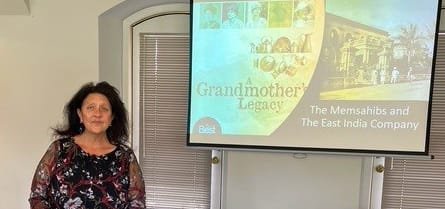
In her evocative talk, “A Grandmother’s Legacy: The Memsahibs and the East India Company,” researcher and author Jenny Mallin provides a sweeping narrative that bridges the gap between a 170-year-old family recipe book and the grand architecture of the British Empire. Mallin, whose family roots in India span five generations, repositioned the history of the “memsahib” not merely as a colonial trope, but as a central figure in the world’s first global corporate expansion.
The Rise of the First Multinational
The talk covered a period of c. 400 years commencing 1617 when the East India Company (EIC) was created; its purpose was to make money and they were able to achieve this by establishing a tea trade, initially to England—this eventually became a lucrative monopoly. The Company was formed, initially, to trade in the Indian Ocean but found lucrative markets elsewhere such as China.
During the initial stages of the trading, tea became the fashionable drink of the day. Without the East India Company there would not have been the imperial British Raj in India in the 19th and 20th centuries; it was the world’s first multinational corporation which helped shape the modern global economy; it was headquartered in London.
The Memsahib: Entrepreneurship and Influence
Mallin challenged the common misconception that European women only arrived during the high Raj. We often think that memsahibs are linked only to the British Raj, in fact the very first memsahibs were to land in India as early as 1617, they came with one thing on their mind: how to make money in running a business on their own. We discovered how the Tea Trade to England would become a lucrative monopoly for the EIC thanks to Catherine of Braganza, the young Portuguese wife of Charles II who served it to her aristocratic friends and soon tea would become the fashionable drink of the day.
Beyond the palace, memsahibs in India faced gruelling conditions. Mallin described “The Fishing Fleet” – young women who travelled to India in search of husbands, often facing the “social stigma of spinsterhood” if they failed to secure a match within a year. Once established, these women managed vast households, often overseeing up to 20 servants, as each servant was only permitted to perform a small range of tasks befitting their cast or status. They acted as amateur doctors, navigating tropical diseases like typhoid and malaria, and served as the keepers of British domesticity in a foreign land.
Mallin’s own “legacy” (her book) – the handwritten culinary manuscripts of her ancestors – serves as a testament to their resilience, documenting how they blended English tastes with Indian spices to create a unique Anglo-Indian identity that persists today.