
Henley Men’s Probus held it’s 526th meeting at Badgemore Golf Club on Tuesday, 13 October 2026. The meeting was opened by Chairman Tony Cobb who welcomed all members and asked us all to remember Alan O’Dair who passed away a few weeks ago. Club President Viv Emerson gave a short talk highlighting that Alan had been our longest serving member having joined the club in 1988.
Tony briefed that the outing to the Standlake winery had been very successful and was enjoyed by our members and those of Henley Ladies Probus who had joined us. He further briefed that the committee had decided that Greener Henley will be one of the organisations put forward for a donation from our charity fund.
We had a fascinating talk from Peter Hague entitled Cabbage, Crackers and Tea. The title is a play on words for Savoy Cabbage, Ritz Crackers and Fortnum and Mason Tea which were the subject of his talk. He spoke of the lives and background of Cesar Ritz and Auguste Escoffier who worked in partnership for many years having both started in the hotel and restaurant trades. They had worked together in the Grand Hotel in Monaco where Ritz was a manager and Escoffier was the head chef.
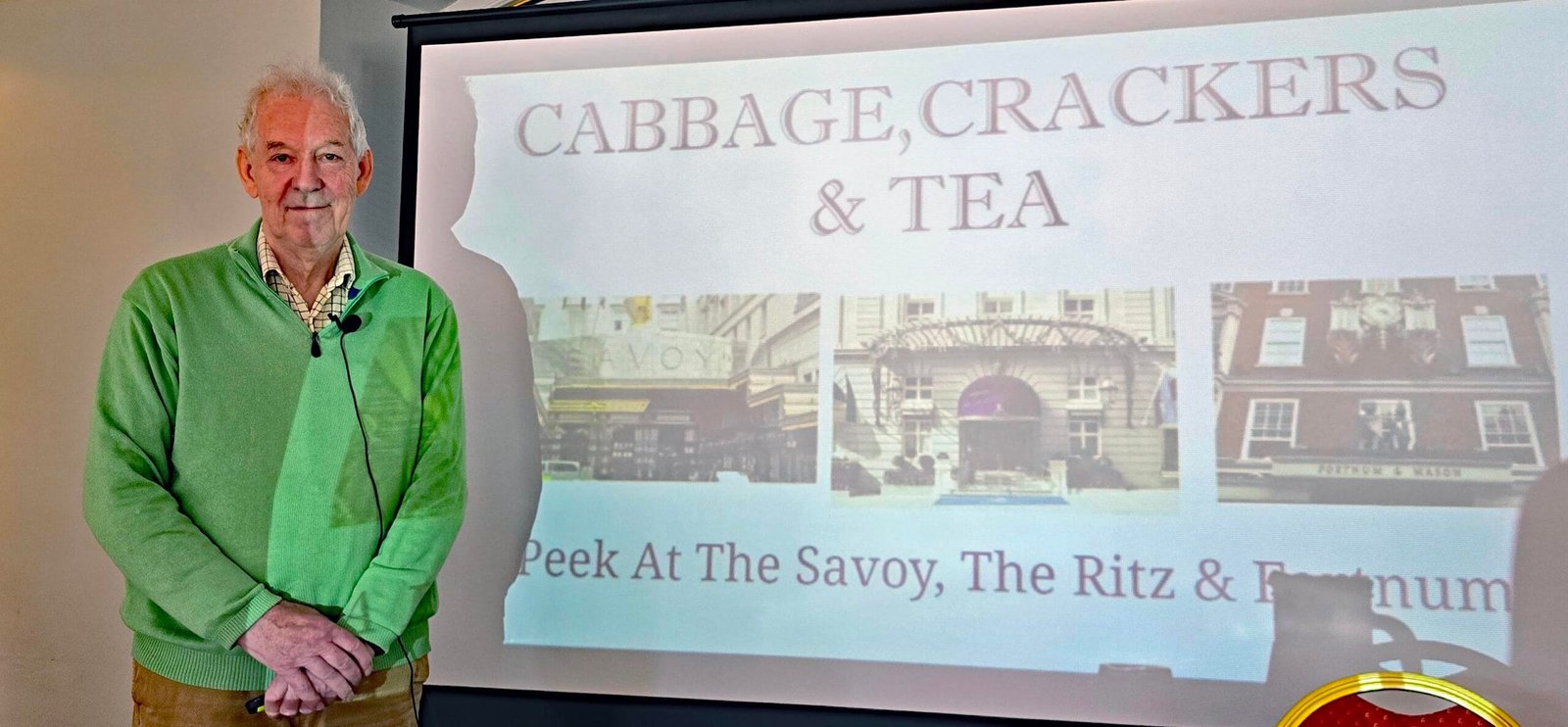
Peter then spoke of Richard D’Oyly Carte who had run a theatrical agency the clients of which included Oscar Wilde and J.M. Whistler. He was the one credited with bringing together Gilbert and Sullivan and was responsible for creating the Savoy theatre and hotel. Peter recounted the early history of the Savoy including the fact that it frequented by the royalty of the day. He then explained how Ritz and Escoffier had opened the Ritz in Paris and subsequently the Ritz in London and spoke of many of the famous and influential people who had frequented the London establishment to include the Prince of Wales, John Paul Getty, Neil Armstrong and the Queen Mother.
Peter then focused his talk on the creation of Fortnum and Mason and explained how William Fortnum and Hugh Mason came together in 1707 to found the world famous grocery business. Fortnum had worked for the royal family and Mason was his landlord and together they set up in business originally selling the used candles from the palace as the royal family insisted on using new candles every day! The London store is famous not only for specialty teas and hampers but also for the clock which is outside of their London premises. Peter spoke of the famous F&M hampers which were started in the 1730s and were purchased by early travellers who wanted to take more upmarket provisions with them on their journeys. F&M had, and continue to have, a close relationship with the British military and have sent hampers out to troops dating back to the time of the Crimean War. They also sent hampers to the suffragettes.
Peter concluded his most interesting talk by explaining the history of afternoon tea which, today, can be taken in the Savoy, the Ritz and Fortnum & Mason’s.
The histories of London’s most legendary luxury institutions – The Savoy, The Ritz, and Fortnum & Mason – are tightly woven together by shared visionaries, culinary innovation, and an unwavering commitment to high-society hospitality.
Fortnum & Mason is the oldest of the trio, founded in 1707 by William Fortnum, a footman to Queen Anne, and his landlord, Hugh Mason. Fortnum astutely profited by reselling half-used royal wax candles, using the proceeds to open a grocery shop in Piccadilly. By the 19th century, Fortnum’s had become an indispensable provider to the aristocracy, renowned for culinary creativity—including inventing the Scotch egg in 1738—and supplying provisions to royal households and far-flung military expeditions.
Nearly two centuries later, theatrical impresario Richard D’Oyly Carte fundamentally reshaped London’s luxury landscape. Having amassed a fortune producing Gilbert and Sullivan’s comic operas at his Savoy Theatre, D’Oyly Carte envisioned a hotel of unprecedented opulence to cater to his wealthy American and European theater patrons. In 1889, he opened The Savoy, Britain’s first luxury hotel powered by electric lights and fitted with en-suite bathrooms.
To ensure its success, D’Oyly Carte poached hotelier César Ritz as manager and master chef Auguste Escoffier as chef de cuisine in 1890. Escoffier, dubbed the “King of Chefs and Chef of Kings,” revolutionized fine dining at The Savoy by establishing the organized kitchen brigade system and creating famous dishes like Peach Melba. Ritz brought refined service and modern social flair, encouraging high-society women to dine in public for the first time. D’Oyly Carte’s ambitious vision had successfully created the premier social hub of Victorian London.
When financial disputes led Ritz and Escoffier to part ways with D’Oyly Carte’s company in 1897, the legendary duo carried their philosophy forward. In 1906, César Ritz opened The Ritz London on Piccadilly—just steps away from Fortnum & Mason. Designed with opulent French Chateau architecture and Louis XVI interiors, it immediately rivaled The Savoy. Meanwhile, D’Oyly Carte’s family continued to manage The Savoy and later expanded their empire to include Claridge’s and The Berkeley, solidifying their own legacy in luxury management.
Together, these institutions formed a golden triangle of London prestige: Fortnum & Mason refined the art of fine provisions, D’Oyly Carte pioneered modern luxury hotel management, and Ritz and Escoffier elevated gastronomy and service. Today, all three remain global benchmarks of elegance, carrying forward the visionary traditions established by their founders.